
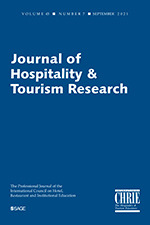
Journal of Hospitality & Tourism Research
Hospitality, Travel & Tourism Management | Marketing (General) | Services Marketing
Established in 1976, the Journal of Hospitality & Tourism Research (JHTR) plays a major role in incubating, influencing, and inspiring hospitality and tourism research. JHTR publishes original research that clearly advances theoretical development and offers practical value for hospitality and tourism ecosystems. JHTR strives to publish research with IMPACT – JHTR publications are expected to be Innovative, Meaningful, Practically relevant, Academically rigorous, Cross-disciplinary, and Theory-focused. Read the complete description of our guiding editorial principles.
This journal is a member of the Committee on Publication Ethics (COPE).
Submit your manuscript today at https://mc.manuscriptcentral.com/jhtr.
We follow the guiding editorial principles of IMPACT – JHTR publications are expected to be Innovative, Meaningful, Practically relevant, Academically rigorous, Cross-disciplinary, and Theory-focused.
Innovative – JHTR strives to be an incubator for original and thought-provoking research. To be considered for JHTR publication, the manuscript must provide new and insightful ways of exploring and conceptualizing an issue; offer different, unique, or controversial perspectives on a research topic; and/or bring together ideas, theories, and concepts in novel and thought-provoking ways. We particularly welcome cutting-edge research that inspires, provokes, excites, and engages our audiences. Research that simply replicates previous work in a different context or geographical location is not generally considered as making a significant contribution unless it presents novel perspectives or interprets the findings in ways that expand our understanding of the phenomena. Likewise, if incremental extensions in the form of replicating previous work with the addition of some elements do not significantly alter the prediction or application of a theory, contribution to knowledge creation is likely limited. Methodological novelty or sophistication in and of itself cannot compensate for inadequate theoretical and practical merits. Interesting research may take many forms, but the surest methods for creating such research is to challenge a commonly accepted theory, proposition, practice, or assumption, or examine new phenomena with a goal to generate new knowledge.
Meaningful – JHTR contributions should appeal to a broad range of academic and non-academic audiences and address issues that are meaningful and significant to scholars as well as non-academic stakeholders such as practitioners, policy makers and/or consumers in hospitality and tourism and related fields. Work published in JHTR may also strive to demonstrate the societal impact of the findings. Studies addressing key societal challenges as related to hospitality and tourism are of particular interest to the JHTR readership.
Practically relevant – Research articles published in JHTR should have practical relevance. Authors must clearly address the “so what” question by highlighting the managerial and policy implications of their research. Although research findings should have translational impact on firms, destinations, communities, governments, society and beyond, submissions that are primarily practitioner-oriented and written with industry managers as the target audience may be more suitable for a practitioner journal.
Academically rigorous – JHTR contributions must be conceptually and methodologically rigorous. Research published in JHTR should have progressed through a rigorous, proper, and stringent knowledge development process that ensures that the output is academically sound. At the conceptual level, authors must identify a clear theoretical approach and articulate how the research advances our understanding of particular topics, concepts, or theories. We welcome a variety of methodological approaches, as appropriate to the research conducted. For quantitative research, authors should provide detailed information pertaining to data collection, sampling strategies, survey design, experimental manipulations, and measurement. Qualitative research should be conducted under the tenets of a specified research tradition. Regardless of the approach, all methodologies should be described in a manner that allows for replication and the research demonstrate evidence of reliability and validity in their corresponding methodological traditions.
Cross-disciplinary – Hospitality and tourism research is often enriched by exploring phenomena through the lens of other disciplines. Likewise, hospitality and tourism offer interesting and rich contexts that can help to shape the content and boundaries of studies in allied fields. Accordingly, where applicable, JHTR supports and encourages cross-disciplinary collaborations as well as contributions from scholars in other disciplines.
Theory-focused – JHTR strives to be a powerhouse for the cultivation of concepts, frameworks, models and theories that extend our understanding of relevant hospitality and tourism phenomena and inform the direction of future research. We particularly encourage and champion the development of theories and frameworks that originate from the hospitality and tourism field. Accordingly, contributing authors should pay particular attention to the interplay between concepts and contexts to create opportunities for theory building that captures the complexities, intricacies, and dynamics of hospitality and tourism phenomena.
| Jean-Pierre van der Rest | Leiden University, Netherlands |
| Peter B. Kim | Auckland University of Technology, New Zealand |
| Li Miao | University of Macau, China |
| Tom Powers | 1976-1979 |
| Leo Renaghan | 1980-1982 |
| Abraham Pizam | 1983-1989 |
| Bob Bosselman and Jeff Fernsten (interim) | 1989-1990 |
| Carolyn Lambert and Carl Riegel | 1990-1995 |
| Kaye Chon | 1996-2008 |
| Anna Mattila | 2009-2015 |
| Chris Roberts and Linda Shea | 2016-2020 |
| Albert Assaf | University of Massachusetts Amherst, USA |
| Melissa Baker | University of Massachusetts Amherst, USA |
| Martin Falk | University of South-Eastern Norway, Norway |
| Lawrence Hoc Nang Fong | University of Macau, Macau SAR |
| Phillip Jolly | Pennsylvania State University, USA |
| Mahmood Khan | Virginia Tech, USA |
| Sangkyun (Sean) Kim | Edith Cowan University, Australia |
| Seontaik Kim | Morgan State University, USA |
| Ceridwyn King | Purdue University, USA |
| Xinran Lehto | Purdue University, USA |
| Gang Li | University of Surrey, UK |
| Nathaniel Line | Florida State University, USA |
| Lu Lu | Temple University, USA |
| Breffni Noone | The Pennsylvania State University, USA |
| H. G. Parsa | University of Denver, USA |
| Christopher Seow | University of Warwick, UK |
| Marianna Sigala | University of Newcastle, Australia |
| David Solnet | The University of Queensland, Australia |
| Bruce Tracey | Cornell University, Ithaca, USA |
| Ying Wang | The Hong Kong Polytechnic University, Hong Kong SAR |
| Wei Wei | University of Central Florida, USA |
| Cheri Young | University of Denver, USA |
| Daniel Leung | The Hong Kong Polytechnic University, Hong Kong, China |
| Graziano Abrate | University of Piemonte Orientale, Italy |
| Julia Albrecht | University of Otago, New Zealand |
| Robin M. Back | University of Central Florida, USA |
| So Young Bae | Kyung Hee University, South Korea |
| Seyhmus Baloglu | University of Nevada, Las Vegas, USA |
| Carl A. Boger Jr. | University of Houston, USA |
| David Boto-García | University of Oviedo, Spain |
| Dimitrios Buhalis | Bournemouth University, UK |
| Kenneth Butcher | Mae Fah Luang University, Chiang Rai, Thailand |
| Lisa Cain | Florida International University, USA |
| Neil Carr | University of Otago, New Zealand |
| Irene Cheng Chu Chan | Macao Institute for Tourism Studies, Macau SAR |
| Robin Chark | University of Macau, Macau SAR, China |
| Prakash Chathoth | American University of Sharjah, United Arab Emirates |
| Annie Chen | University of Roehampton, UK |
| Ganghua Chen | Sun Yat-sen University, China |
| Nan Chen | Hong Kong Polytechnic University, Hong Kong |
| Mingming Cheng | Curtin University, Australia |
| Monica Chien | The University of Queensland, Australia |
| Hyeyoon (Rebecca) Choi | Ohio University, USA |
| David Corsun | University of Denver, USA |
| Jonathon Day | Purdue University, USA |
| Cynthia Deale | East Carolina University, USA |
| Fred DeMicco | Northern Arizona University, USA |
| Tarik Dogru | Florida State University, USA |
| Abrar Faisal | Auckland University of Technology, New Zealand |
| Alei Fan | Purdue University, USA |
| Daisy Fan | Bournemouth University, UK |
| Marcela Fang | William Angliss Institute of TAFE, Australia |
| Sebastian Filep | Hong Kong Polytechnic University, Hong Kong, SAR |
| Fabian Frenzel | Oxford Brookes University, UK |
| Xiaoxiao Fu | University of Central Florida, USA |
| Martina Gallarza | University of Valencia, Spain |
| Yixing Lisa Gao | The Hong Kong Polytechnic University, Hong Kong SAR |
| Susan Gordon | Purdue University, USA |
| Ulrich Gunter | MODUL University Vienna, Austria |
| Dogan Gursoy | Washington State University, USA |
| Renata Guzzo | University of Nevada Las Vegas, USA |
| Heesup Han | Sejong University, Korea |
| Murat Hancer | University of Central Florida, USA |
| Zeya He | Shandong University, China |
| Zeya He | Shandong University, China |
| Jo Ann Ho | Universiti Putra Malaysia, Malaysia |
| Yuansi Hou | University of Macau, China |
| Huiling Huang | University of Macau, Macau |
| Zhuowei (Joy) Huang | Sun Yat-sen University, China |
| YooHee Hwang | The Hong Kong Polytechnic University, Hong Kong, China |
| Jinyoung Im | Oklahoma State University, USA |
| Bona Kim | Inha University, South Korea |
| Ellen E. Kim | California State University, Fullerton, USA |
| Eojina Kim | Virginia Tech, USA |
| Hyun Jeong Kim | Washington State University, USA |
| Jin Young Kim | Kyung Hee University, South Korea |
| Kawon Kim | University of South Carolina, USA |
| Woo-Hyuk Kim | Incheon National University, Korea |
| Ko Koens | Inholland University of Applied Sciences, Netherlands |
| Yoon Koh | University of Houston, USA |
| Metin Kozak | Kadir Has University, Turkey |
| Henri Kuokkanen | Institut Paul Bocuse, France |
| Linchi Kwok | California Polytechnic University, USA |
| Rob Law | University of Macau, China |
| Gyumin Lee | Kyung Hee University, South Korea |
| Kam-hon Lee | The Chinese University of Hong Kong, Hong Kong SAR |
| Seoki Lee | The Pennsylvania State University, USA |
| Seonjeong (Ally) Lee | Purdue University, USA |
| Seul Ki Lee | Sejong University, South Korea |
| Tiffany S. Legendre | University of Houston, USA |
| Ming Lei | Beijing International Studies University, China |
| Soey Lei | University of Macau, Macau SAR, China |
| Xi Yu Leung | Kansas State University, USA |
| Chunxiao Li | Nankai University, China |
| Neil Li | The Hong Kong Polytechnic University, Hong Kong SAR |
| Shanshi Li | Xiamen University, SAR-China |
| Xiangping Li | Macao Institute for Tourism Studies, Macao, China |
| Xiaoxiao Li | University of Central Florida, USA |
| Meizhen Lin | Huaqiao University, China |
| Zhiwei (CJ) Lin | Sun Yat-sen University, China |
| Anyu Liu | Texas A&M University, USA |
| Han Liu | Jilin University, China |
| Jing Liu | Macau University of Science & Technology,Macau SAR |
| Tingting Liu | Xiamen University, China |
| Ada Lo | The Hong Kong Polytechnic University, Hong Kong SAR |
| Emily (Jintao) Ma | University of Surrey, UK |
| Juan Madera | University of Houston, USA |
| Vincent P. Magnini | Longwood University, USA |
| Michael McCall | Michigan State University, USA |
| Sean McGinley | Florida State University, USA |
| Hyounae (Kelly) Min | California Polytechnic State University Pomona, USA |
| Sung Gyun Mun | The Hong Kong Polytechnic University, Hong Kong |
| Birgit Muskat | Australian National University, Australia |
| Birgit Muskat | Australian National University, Australia |
| Annmarie Nicely | Purdue University, USA |
| John O'Neill | The Pennsylvania State University, USA |
| Chihyung "Michael" Ok | Temple University, USA |
| Fevzi Okumus | University of Central Florida, USA |
| Eerang Park | Edith Cowan University, Australia |
| In-Jo Park | Jeonbuk National University, South Korea |
| Luis N. Pereira | University of Algarve, Portugal |
| Marko D. Petrovic | Serbian Academy of Sciences and Arts, Serbia |
| Richard Qiu | The Hong Kong Polytechnic University, Hong Kong SAR |
| Lianping (Eve) Ren | Macao Institute for Tourism Studies, Macao, China |
| Dennis Reynolds | University of Houston, USA |
| Bongkosh N. Rittichainwat | Siam University, Thailand |
| Richard Robinson | University of Queensland, Australia |
| Ruggero Sainaghi | Università IULM, Italy |
| Maria Sard | University of the Balearic Islands, Spain |
| Zvi Schwartz | University of Delaware, USA |
| Noel Scott | University of the Sunshine Coast, Queensland, Australia |
| Boopen Seetanah | University of Mauritius, Mauritius |
| Kwanglim Seo | University of Hawaii, Manoa, USA |
| Amit Sharma | The Pennsylvania State University, USA |
| Atul Sheel | University of Massachusetts Amherst, USA |
| Manisha Singal | Virginia Tech, USA |
| Amrik Singh | University of Denver, USA |
| Kevin Kam Fung So | Purdue University, USA |
| Siu Ian (Amy) So | University of Macau, Macau SAR |
| Nikolaos Stylos | University of Bristol, UK |
| Michael J. Tews | The Pennsylvania State University, USA |
| Nicholas J. Thomas | Abu Dhabi Hospitality Academy – Les Roches, United Arab Emirates |
| Henry Tsai | The Hong Kong Polytechnic University, Hong Kong SAR |
| Christine Van Winkle | University of Manitoba, Canada |
| Anna de Visser-Amundson | Hotelschool The Hague, Netherlands |
| Chen-ya Wang | Taiwan Tsinghua University, Taiwan |
| Xuan Lorna Wang | University of Surrey, UK |
| Yao-Chin Wang | University of Florida, USA |
| Melvin Weber | East Carolina University, USA |
| Craig Webster | Ball State University, USA |
| IpKin Anthony Wong | Macao Institute for Tourism Studies, SAR-China |
| Jose Weng Chou Wong | Macau University of Science and Technology, Macau SAR |
| Kyle Woosnam | University of Georgia, USA |
| Hung-Che Wu | Nanfang College Guangzhou, China |
| Laurie Wu | Temple University, USA |
| Qu Xiao | The Hong Kong Polytechnic University, Hong Kong SAR |
| Shi (Tracy) Xu | University of Surrey, UK |
| Yang Yang | Temple University, USA |
| Alan Yen | Ball State University, USA |
| Heyao (Chandler) Yu | The Pennsylvania State University, USA |
| Kun Zhang | Nankai University, China |
| Lu Zhang | Michigan State University, USA |
| Xinyuan Roy Zhao | Macau University of Science and Technology, Macau, China |
| Dan Zhu | Auckland University of Technology, New Zealand |
JHTR Manuscript Submission Guidelines
- The Journal of Hospitality & Tourism Research (JHTR), peer-reviewed via a blind process and published eight (8) times per year, publishes original research, both conceptual and empirical, that clearly enhances the theoretical development of the hospitality and tourism field.
- The concept of ‘enhances theoretical development’ is key.
- Studies that extend, amend, or generate new theory or models are preferred.
- The Editors welcome submissions with qualitative, quantitative, or mixed method approaches.
- Findings should be generalizable beyond a specific case or geographical location and this should be made clear in the paper.
- Manuscripts submitted to JHTR should be original contributions not under consideration with any other publication at the same time.
- Articles submitted are subject to a blind review process. The identity of the authors and reviewers remains confidential during the review process. If accepted for review, typically three reviewers, an Associate Editor, and the Executive Editors will be involved in the review process. All reviews will be anonymously shared with both authors and reviewers.
- Manuscripts should not exceed the word counts listed below by category. The word count limit includes all words, all pages, all content, from title page to end of references and appendix, including tables and figures. Submissions must be written in English. Note that the publisher offers a web-based Online Supplement service for extensive supporting materials such as interviews, videos, transcripts, tables, figures, etc., that are not included in the print version.
- Conceptual submissions should not exceed 8,000 words.
- Quantitative submissions should not exceed 8,000 words.
- Qualitative submissions should not exceed 9,000 words.
- Mixed method submissions should not exceed 9,000 words.
- Articles for the Viewpoints and Commentary, Publications in Review, Research Notes, and Industry Viewpoints sections should not exceed 3,500 words (all words, all pages, references, tables and figures included).
- The Rejoinders section of the journal is intended to publish short articles, commentaries, and rebuttals on the contents of JHTR. Rejoinders should not exceed 1,000 words in total length. Authors should submit such contributions immediately after an issue of JHTR is published so that their response appears in the subsequent issue if possible
- Manuscripts should be prepared using 12-point font size and be double-spaced, including references.
- Use only left justification and 1” margins on all four sides.
- Titles should have no more than 15 words; exercise parsimony with a focus upon primary concepts.
- All general editorial formats, abbreviations, use of statistics in text, citations, and references should conform to the Publication Manual of the American Psychological Association (6th edition).
- Manuscripts should be submitted via Sage’s Manuscript Central at http://mc.manuscriptcentral.com/jhtr. The author’s name should not appear anywhere except on the title page, which is uploaded as a separate file from the main document (to preserve anonymity during the review process). Authors will prepare and post two (2) files when making their initial submission.
- In the first file that is uploaded, give the file name the label of Title Page and please include inside that document [1] the name of author(s) and title, [2] author(s) contact details, including present position, complete address, telephone/fax numbers, e-mail address, and then [3] any acknowledgement of financial or technical assistance if appropriate.
- In the second file, include all material that you intend to publish in the print edition. This second file should be uploaded with the file name of Main Document. The first page of this second document should feature the title of the paper (without author’s name), a list of no more than six keywords that define the subject matter, and a brief abstract of no more than 200 words substantively summarizing the article.
- Body: The text, with major headings centered on the page and subheadings flush with the left margin. Major headings should use all uppercase letters; side subheadings should be typed in upper and lowercase letters. No heading is in bold. Do not number the lines of text.
- Hypotheses: quantitative studies that include hypotheses should ensure that both the null and alternative statements are paired for each hypothesis. That is, do not simply present only the alternative statement. List also the null statement, which is the statement actually tested. Present the null first (H10), then the alternative statement (H1a). See this website for more information: http://www.stattrek.com/hypothesis-test/hypothesis-testing.aspx
- Tables and Figures. Each table or figure should be prepared on a separate page and grouped together at the end of the manuscript. Do not create a new document for these items or place them in the body of the paper. The data in tables should be arranged so that similar material reads downward in columns, not across in rows. Nonsignificant decimal places in tabular data should be omitted. The tables and figures should be numbered in Arabic numerals, followed by brief descriptive titles. Authors should indicate in the body of the paper where tables and figures should appear. Additional details should be footnoted under the table, not in the title.
- Typically, because of publishing limitations, 3-5 tables and/or figures will be published with the article in the print version. Additional tables and/or figures can be made available to readers via an online storage medium that is publicly accessible and stored on an open Sage website.
- Lengthy supporting information, such as transcripts, scanned documents, audio or video recordings, etc., can be made available to readers via an online storage medium that is publicly accessible and stored on an open Sage website. If you have material to include in the online supplement, group this information in a 3rd separate file and upload it with the file name of Supplemental Information. Begin this 3rd file with a title on the top of the first page using this format: “Supplemental Information for XXX” – and REPLACE the XXX with the full title of your paper. The end result is a heading at the top of the first page of your supplemental material that identifies it as supplemental material and connects it to your primary paper.
- In the narrative, all illustrations and charts should be referred to as figures. Figures must be clean, crisp, black-and-white, camera-ready copies. Please avoid the use of gray-scale shading; use hatch marks, dots, or lines instead. Do not submit any work in color that is to be printed in the paper version of the journal.
- References should be the most relevant and timely for your topic; be discerning in your choices. Lengthy literature reviews should be avoided. References should appear in APA style (6th edition). Use the assigned DOI where possible when referencing electronic sources. List references alphabetically, principal author’s surname first, followed by publication date in parentheses. The reference list should be double-spaced, with a hanging indent, starting on the top of a separate page. Do not number references. Confirm that all titles cited in the narrative appear in the reference list and vice versa. Please see the illustrative examples below
- Specth, M. L., & Wilkie, D. M. (2012). Subjective shortening: A model of pigeon’s memory for even duration. Journal of Experimental Psychology: Animal Behavior Processes, 29(1), 14-30.
- Tardener, H. (2015, December). Do babies sing a universal song? Psychology Today, 34(2), 70-76. doi:10.1037/rmh0000008
- Weinstein, T. M. K. (1991). The careful writer: A modern guide to the English usage. New York: Atheneum.
- Zachary, A. S., & Kniskern, D. P. (1988). Family therapy outcome research: Knowns and unknowns. In A. S. Gurman & D. P. Kniskern (Eds.), Handbook of family therapy (pp. 742-775). New York: Brunner/Mazel.
- Do not include any acknowledgments or disclose any funding sources in the version(s) of the manuscript intended for peer review. This information can compromise the anonymity of the author(s) during the review process. Such information is only to be included in the Title Page file, which is not shared with reviewers.
- The compilation of the journal issue is copyrighted by International Council on Hotel, Restaurant, and Institutional Education (ICHRIE), but authors retain the copyright for their article. Every author and coauthor must sign a contract before an article can be published.
- Frequency: 8 times per year • ISSN: 1096-3480
- Note to Authors: Authors who want to refine the use of English in their manuscripts might consider utilizing the services of SPi, a non-affiliated company that offers Professional Editing Services to authors of journal articles in the areas of science, technology, medicine or the social sciences. SPi specializes in editing and correcting English-language manuscripts written by authors with a primary language other than English. Visit http://www.prof-editing.com/ for more information about SPi's Professional Editing Services, pricing and turn-around times, or to obtain a free quote or submit a manuscript for language polishing. Please be aware that neither International CHRIE nor SAGE have any affiliation with SPi and make no endorsement of the company. Your use of their services in no way guarantees that your submission will ultimately be accepted. Any arrangement you enter into will be exclusive between yourself and SPi, and any costs incurred are the sole responsibility of the author.